


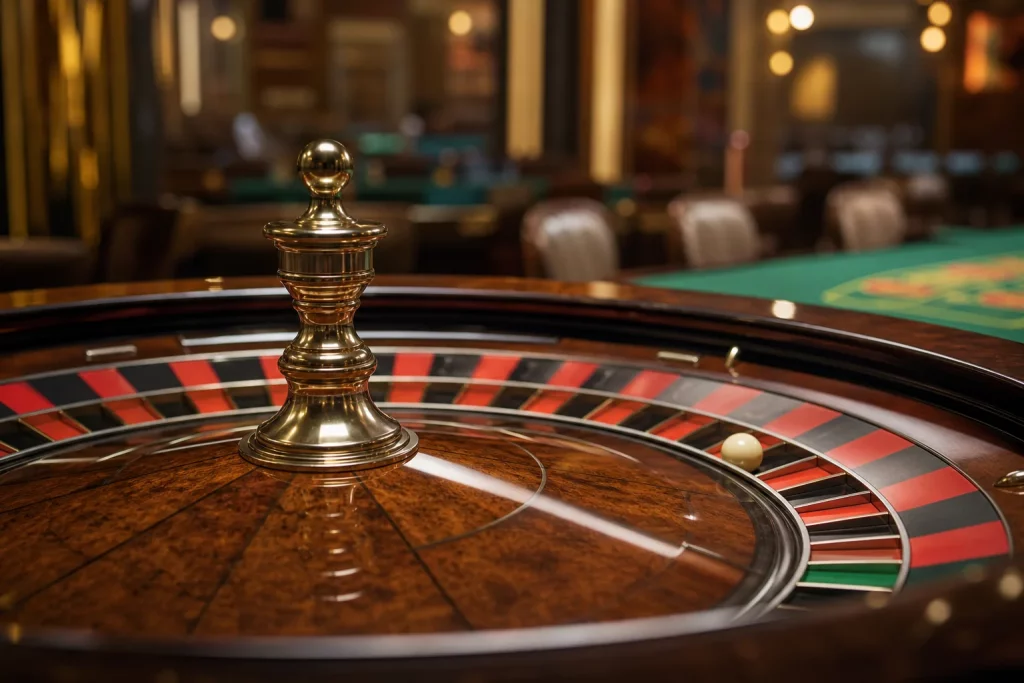
The roulette ball skitters across polished wood, bouncing between red and black until physics and friction choose its final resting place. The dice tumble across green felt. The slot reels blur into motion. Every one of these moments feels like pure chance, but they’re not. They’re probability executing with mathematical precision. Understanding the math behind casino games won’t help you beat the house—but it will transform you from a hopeful gambler into an informed player who knows exactly what you’re up against every time you place a chip. This is your guide to the invisible architecture that powers every casino game, explained in plain English without the textbook jargon.
The Foundation: What Probability Actually Means in a Casino
Walk into any casino in Las Vegas, Atlantic City, or Macau, and you’re entering a meticulously calibrated mathematical laboratory. The spinning roulette wheels, shuffled cards, and flashing slot machines aren’t instruments of chance—they’re precision-engineered probability machines designed to produce predictable results over time.
Probability in gambling terms measures the frequency of specific outcomes expressed as a ratio or percentage. When a craps shooter rolls two dice, there are exactly 36 possible combinations. Seven appears in six of those combinations, giving it a 16.67% probability—the highest of any total. This isn’t guesswork. It’s mathematical certainty.
What separates professional gamblers from tourists feeding the slot machines is understanding that casino games operate on fixed mathematical principles that never fluctuate. A European roulette wheel always has 37 pockets. The probability of hitting a single number remains 1 in 37 whether it’s your first spin or your thousandth, whether red has appeared ten times consecutively or not at all.
Why Every Spin, Roll, and Deal Follows Mathematical Rules
The randomness players perceive masks underlying mathematical structure. Each card dealt, die rolled, or slot reel stopped represents a discrete event with calculable odds. Video poker machines with optimal play can achieve return-to-player rates of 99.5% or higher, offering some of the best probability outcomes in casino gaming. These aren’t arbitrary numbers—they’re programmed into the machine’s algorithm based on standard deck probabilities and payout schedules.
The Law of Large Numbers: How Casinos Always Win in the End
Casinos don’t gamble. They collect mathematical rent. The Law of Large Numbers ensures that as bets accumulate into the thousands and millions, actual results converge toward theoretical probabilities. A single player might walk away with $10,000 after a lucky night, but across 50,000 players making a million bets, the house edge executes with surgical precision. This is why casinos measure performance in “drop” and “hold percentage” rather than individual sessions—they’re tracking mathematical inevitability, not luck.
The House Edge: Casino Gambling’s Built-In Advantage
Every chip placed on a casino table carries an invisible tax. The house edge represents the mathematical percentage casinos extract from wagers over time, and it’s the reason casino resorts rise higher than the Strip skyline while most players eventually walk away lighter. This built-in advantage doesn’t prevent individual wins—players hit jackpots and walk away winners every day—but it guarantees that across thousands of bets, the casino always comes out ahead.
The law of large numbers transforms this mathematical edge into reliable profit. While you might beat the house tonight, across millions of collective wagers from thousands of players, the casino’s expected return materializes with statistical certainty. On American roulette, that edge sits at 5.26%, meaning players surrender $5.26 of every $100 wagered on average over extended play. The extra double-zero pocket compared to European wheels creates this premium for the house.
How House Edge Varies Across Popular Games
Casino games offer dramatically different value propositions for players. The spread between the best and worst bets can exceed 500 basis points:
- Blackjack with basic strategy: under 0.5%
- Baccarat banker bet: 1.06%
- Craps pass line: 1.41%
- European roulette: 2.70%
- American roulette: 5.26%
- Keno: 25-40%
These percentages explain why serious advantage players gravitate toward blackjack tables while casual players feed slot machines and keno lounges. The difference between a 1% and 5% edge might seem trivial, but over a weekend of play, it determines whether you’re battling a slight headwind or a mathematical gale.
What a 5% Edge Really Means for Your Bankroll
A 5% house edge doesn’t mean losing 5% of your bankroll in a single session. You might win or lose 50% in an evening’s play due to variance and luck. Instead, this percentage reflects the grind of total action. Wager $2,000 across an evening of roulette—through wins, losses, and re-bets—and statistical expectation places your net loss around $105. Some nights you’ll defy these odds. Most nights, given enough spins, the math wins.
Independent Events and the Gambler’s Fallacy
Walk into any casino and you’ll witness a peculiar ritual: players crowding around roulette tables after a string of blacks, convinced red is “due.” They’re chasing a phantom. Every spin, every roll, every digital slot reel operates in a vacuum of probability where the past doesn’t exist.
The gambler’s fallacy represents the single most expensive misconception in gambling—the belief that previous outcomes somehow influence future results. When a roulette wheel lands on black ten times consecutively, the odds of red on spin eleven remain exactly 18/38 on an American wheel, identical to every spin before it. The wheel possesses no memory, no cosmic balancing mechanism. Those ten blacks were simply probability playing out in its infinite variations, not a debt the universe owes to red numbers.
Why Slot Machines Have No Memory
Modern slot machines operate through random number generators running perpetually, cycling through thousands of combinations per second even when idle. The moment you press that button, the RNG stops on whatever number sequence it’s currently processing—typically completing this selection in microseconds. That result was predetermined the instant your finger made contact, rendering every notion of “hot” or “cold” machines meaningless. Whether the previous player walked away after a jackpot or twenty losing spins has zero bearing on your outcome. The machine doesn’t track winning streaks or compensate for losses.
The Roulette Wheel Doesn’t Remember Yesterday
The physical reality of roulette reinforces this independence. Each spin involves a ball traveling across a precisely balanced wheel, subject to physics and friction, not historical debt. Casinos understand this perfectly—they display electronic boards showing the last twenty numbers specifically to exploit the gambler’s fallacy, encouraging players to bet against streaks that have no predictive power whatsoever. That board isn’t providing useful data; it’s selling an illusion of patterns where only randomness exists.
Expected Value: What You’ll Really Win (or Lose) Over Time
Walk into any casino with $100 and place a bet on red at the roulette table. You’ll either walk away with $200 or nothing, right? Not quite. Mathematically, you’re walking away with $94.74—at least over the long run. That’s expected value, the single most important number in gambling that tells you what a bet is actually worth beyond the thrill of any single spin.
Calculating What a Bet Is Really Worth
Expected value multiplies each possible outcome by its probability, then adds them together. On an American roulette wheel with 38 pockets, your $100 bet on red has an 18/38 chance of winning $100 and a 20/38 chance of losing $100. The calculation looks like this: (18/38 × $100) + (20/38 × -$100) = -$5.26. Every time you place that bet, you lose an average of $5.26, even though you can’t actually lose $5.26 on a single spin.
This works for any wager. A $10 pass line bet in craps has an expected value of -$0.14. A $5 slot machine spin on a 95% RTP machine returns an expected -$0.25. The numbers vary, but the direction never does.
Why All Casino Games Have Negative Expected Value
Casino games are engineered with mathematical precision to ensure negative expected value for players. The house edge guarantees that every bet, averaged across thousands of trials, transfers money from player to casino. A blackjack table with perfect basic strategy might offer a house edge below 0.5%, making it one of the best bets on the floor. But “best” still means negative. Even finding games with favorable rules only reduces how much you lose per hour, not whether you lose.
Understanding expected value doesn’t make gambling less entertaining. It makes you smarter about which games offer mathematical value and which are designed to empty your wallet fastest.
Game-by-Game Probability Breakdown: Where Your Money Goes Furthest
Walk into any casino and you’re surrounded by flashing lights, spinning wheels, and the promise of fortune. But behind the spectacle lies cold mathematics that determines exactly how much of your bankroll will survive the night. Understanding which games offer the best odds isn’t just academic—it’s the difference between entertainment and financial hemorrhaging.
Table Games: Blackjack, Craps, and Roulette Compared
The hierarchy of probability is unforgiving. At the summit sits blackjack, where a player armed with basic strategy faces a house edge of just 0.5%. That translates to losing roughly 50 cents for every $100 wagered over time—assuming you’re not deviating from optimal play when the dealer shows a six.
Craps presents a more complex landscape, but savvy players know the golden bets. The pass line carries a 1.41% house edge, while the don’t pass bet shaves that to 1.36%. These straightforward wagers make craps the second-best mathematical proposition on the floor, though the dozens of sucker bets scattered across the layout can quickly erode that advantage.
Roulette reveals how a single rule change shifts the odds dramatically. European wheels, with their single zero, impose a 2.7% house edge. American wheels add a double zero, nearly doubling the casino’s advantage. That extra pocket costs you roughly $2.50 per $100 wagered compared to its European cousin.
| Game | House Edge | $100 Expected Loss |
|---|---|---|
| Blackjack (basic strategy) | 0.5% | $0.50 |
| Craps (don’t pass) | 1.36% | $1.36 |
| Baccarat (banker bet) | 1.06% | $1.06 |
| European Roulette | 2.7% | $2.70 |
| American Roulette | 5.26% | $5.26 |
Slots and Video Poker: Understanding RTP and Variance
Slot machines dominate casino floors for good reason—they’re profit engines with house edges typically ranging from 3% to 8%. Most machines operate on RTPs between 92% and 97%, meaning they return that percentage of wagered money over millions of spins. A 95% RTP sounds generous until you realize the casino keeps a nickel of every dollar faster than any table game except American roulette.
Baccarat occupies a unique middle ground. The banker bet’s 1.06% edge delivers consistent, low-variance results that appeal to high rollers seeking steady action without wild swings.
Variance and Volatility: Why You Can Win Big or Lose Fast
Walk into any casino and you’ll notice two very different types of players: the baccarat regular grinding out hand after hand with modest wins and losses, and the slots enthusiast chasing that life-changing jackpot despite hours of dead spins. The mathematical concept separating these experiences is variance—the measure of how wildly your results can swing from the expected average in the short term.
Think of variance as the game’s personality. A roulette wheel spinning red ten times in a row doesn’t break probability; it demonstrates variance in action. Every casino game delivers its house edge over millions of trials, but variance determines whether you experience that edge as a slow bleed or a roller coaster of euphoric wins and crushing losses.
High Variance vs. Low Variance: What’s Your Risk Tolerance?
Baccarat exemplifies low variance. Bet on the banker, and you’re facing nearly a coin flip with consistent, predictable outcomes. You won’t double your bankroll in ten minutes, but you also won’t vaporize it before your drink arrives. Craps pass line bets follow similar patterns—steady action without extreme swings.
High variance games tell a different story. Video poker players chasing a royal flush face approximately 40,000 hands between hits. That’s roughly 100 hours of play at a brisk pace. The 800-to-1 payout creates the game’s appeal, but the mathematics guarantee long, punishing droughts between victories. Most players never see one.
Why Slots Can Pay Huge but Often Don’t
Modern slot machines represent variance at its most extreme. Progressive jackpots advertise million-dollar prizes while delivering nominal returns for hours. The game’s random number generator distributes payouts across an enormous range—from nothing to transformative wealth. This volatility attracts dreamers willing to endure countless losing sessions for a shot at the big score.
Understanding your variance tolerance shapes smarter gambling decisions. Conservative bankrolls suit low-variance games. Risk-seeking personalities with deeper pockets can weather the storms high-variance games deliver. Neither approach changes the house edge, but matching volatility to temperament prevents the psychological damage of playing the wrong game for your personality.
Can You Beat the Odds? Card Counting and Betting Systems
The holy grail of gambling is finding a way to tip the scales in your favor. While casinos engineer nearly every game to guarantee their profit, one technique has genuinely succeeded in shifting probability away from the house. The catch? It requires skill, discipline, and it only works on one game.
Card Counting: The Only Proven Way to Shift the Odds
Card counting in blackjack remains the sole legitimate method for gaining a mathematical edge over the casino. By tracking the ratio of high cards (tens, face cards, aces) to low cards (2-6) remaining in the deck, skilled counters can identify moments when the probability swings in their favor by 0.5-1.5%.
The math is elegant. When the remaining deck is rich in high cards, players have better odds of hitting blackjack (paying 3:2), while the dealer is more likely to bust when forced to hit stiff hands. Counters increase their bets during these favorable situations and minimize wagers when the deck favors the house.
MIT students famously exploited this advantage in the 1990s, winning millions before casinos caught on. But counting isn’t illegal—it’s just unwelcome. Casinos now employ countermeasures: continuous shuffling machines, cutting deeper into shoes, and sophisticated surveillance to identify counting patterns.
Why Betting Systems Like Martingale Always Fail
The Martingale system promises mathematical certainty: double your bet after every loss, and you’ll eventually recoup everything plus a small profit. Sounds foolproof. It isn’t.
Here’s why progressive betting systems collapse:
- Table limits cap your ability to keep doubling indefinitely
- Bankroll constraints mean you’ll hit financial reality before recovering losses
- The house edge persists regardless of bet sizing—probability doesn’t care about your betting pattern
A player starting with a $10 bet on roulette reaches a $1,280 wager after just seven consecutive losses. Most tables max out at $500-$1,000, killing the progression. Even with unlimited funds and no table limits, you’re still playing a negative expectation game. Betting systems simply redistribute the same mathematical disadvantage across different risk profiles—they can’t eliminate it.
Playing Smart in a Mathematical Universe
Probability is the invisible architecture supporting every casino game, the mathematical blueprint that ensures the house always wins over time. But understanding this reality doesn’t diminish the entertainment value of gambling—it transforms it. Armed with knowledge of house edges, expected value, and variance, you’re no longer playing blind. You know that blackjack offers better odds than keno, that betting systems can’t overcome mathematical disadvantages, and that the roulette wheel has no memory of yesterday’s spins.
This isn’t about beating the casino. It’s about playing with eyes wide open, choosing games that offer the best mathematical value, avoiding costly fallacies, and treating gambling as informed entertainment rather than a path to riches. The next time you sit at a table or press a slot button, you’ll understand exactly what you’re up against. That knowledge won’t change the odds, but it will change how you play them—and that makes all the difference between a gambler chasing illusions and a player who understands the game.