


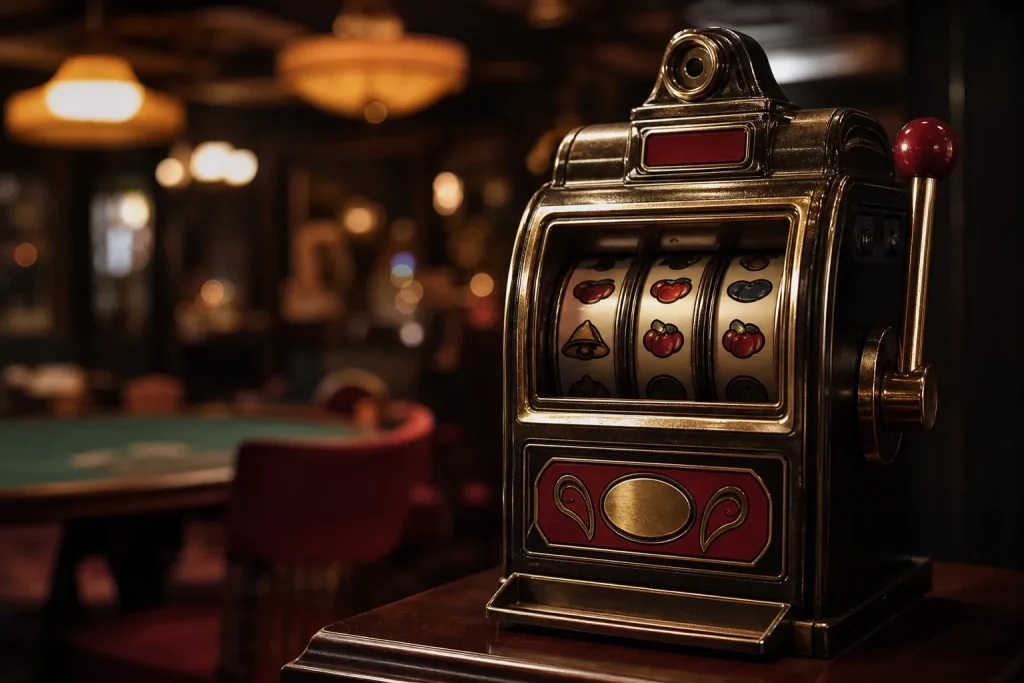
In 1895, a German immigrant named Charles Fey tinkered with gears and springs in his San Francisco workshop and accidentally created the most profitable casino device in history. His Liberty Bell machine—a cast-iron cabinet with three spinning reels and automatic payouts—ignited an industry that now generates the majority of casino revenue worldwide. This isn’t merely a story of technological advancement. It’s the evolution of how a simple mechanical contraption transformed into a digital ecosystem spanning casino floors, smartphones, and virtual reality headsets. From physical reels governed by gravity to random number generators cycling through billions of combinations per second, the slot machine’s journey reveals how technology reshaped gambling itself—and why these games continue to dominate an industry worth billions.
The Mechanical Era: Liberty Bell and the Birth of Slot Gaming (1895-1960s)
San Francisco, 1895. Charles Fey, a German immigrant and mechanical engineer, assembled gears, springs, and three metal reels in his workshop at 406 Market Street. What emerged would transform gambling forever: the Liberty Bell, a cast-iron cabinet housing the world’s first true slot machine. Unlike poker machines that required bartenders to distribute prizes manually, Fey’s invention paid winners automatically through a coin chute. Three cracked Liberty Bells aligned on the center payline delivered the maximum payout of fifty cents—ten nickels clanking into the tray.
The machine’s genius lay in brutal simplicity. Five symbols adorned the reels: horseshoes, diamonds, spades, hearts, and that iconic cracked Liberty Bell. Players inserted a nickel, pulled the lever, and watched physics determine their fate. No electronics. No randomization chips. Just metal teeth, physical stops, and gravity.
How Mechanical Reels Actually Worked
Inside the cabinet, pulling the lever released a tightly wound spring that spun the reels. As each reel lost momentum, a notched brake would catch on metal stoppers, one symbol at a time clicking into position. The reel strips—actual metal discs with symbols stamped or painted on—determined every possible combination. With three reels and five symbols, only 125 possible outcomes existed (5 × 5 × 5). This limited mathematics kept payouts modest. The largest jackpots rarely exceeded twenty dollars because the coin hopper couldn’t physically hold more without jamming.
The Liberty Bell’s Impact on Casino Floors
Fey never patented his creation, and by 1907, manufacturers across America produced copies under names like Operator Bell and Liberty Bell variants. Saloons installed them beside poker tables. The machines demanded no dealer, no skill, no strategy—just a nickel and hope. That accessibility democratized gambling, pulling in customers who’d never approach a card table. By the 1930s, mechanical slots generated more revenue per square foot than any table game, a dominance that persists today.
The Electromechanical Revolution: Money Honey Changes Everything (1963-1975)
When Bally Manufacturing unveiled Money Honey in 1963, slot attendants across Nevada must have sensed their workload was about to change dramatically. This machine could spit out 500 coins automatically—no attendant needed to crack open the cabinet and count out quarters by hand. That bottomless hopper represented more than convenience. It was the birth of a new species of gambling machine that would dominate casino floors for the next two decades.
Why Automatic Payouts Mattered
Before Money Honey, every win over a few coins required an attendant to verify the jackpot and hand-pay the winner. This slowed down play, limited jackpot sizes to what casinos could reasonably staff for, and created bottlenecks during busy hours. Automatic payouts eliminated this friction entirely. Players could chase 500-coin jackpots without waiting for floor staff. Casinos could offer higher denominations and bigger prizes without proportionally increasing labor costs. The machine paid for itself by keeping players in their seats, spinning continuously.
The Hybrid Mechanical-Electric Design
Money Honey wasn’t fully electronic—it was a clever hybrid. Physical reels still spun behind the glass, driven by electric motors rather than mechanical springs. Players still pulled a lever (though it now triggered an electric switch). The innovation lived in the payout mechanism and logic circuits. Electrical relays handled the calculation and coin dispensing that had previously required pure mechanical ingenuity. This hybrid approach preserved the familiar look and feel while introducing capabilities purely mechanical systems couldn’t match. More importantly, it proved that electronics and gambling could coexist, setting the stage for microprocessors to eventually replace those spinning reels altogether.
Video Screens Arrive: The Fortune Coin Innovation (1976-1980s)
When Fortune Coin Company bolted a modified 19-inch Sony Trinitron television set onto a slot machine cabinet in 1976, casino executives didn’t immediately recognize the seismic shift they were witnessing. The bulky prototype looked more like a science experiment than a gaming revolution, but it represented the first true video slot machine—a technology that would eventually render mechanical reels obsolete and reshape the entire casino floor.
The Las Vegas Hilton Test Run
The Las Vegas Hilton Hotel became ground zero for this experiment when Fortune Coin installed its video prototype on the gaming floor for player testing. Initial reactions were mixed. Players accustomed to watching physical reels spin behind glass now stared at a glowing screen that simulated the same action. Skepticism ran high—many gamblers suspected the video display could be easily manipulated compared to visible mechanical components. The Nevada State Gaming Control Board shared these concerns, subjecting the machine to rigorous testing before granting approval. Once certified, however, the Fortune Coin video slot proved its worth. The technology eliminated mechanical failures that plagued traditional machines, reduced maintenance costs, and opened possibilities that gears and springs could never deliver.
IGT’s Dominance in Video Slot Development
International Game Technology recognized the potential before most competitors. In 1978, IGT acquired Fortune Coin Company and transformed video slot technology from novelty to industry standard. Throughout the 1980s and 1990s, IGT leveraged this acquisition to dominate the market, engineering video platforms that could accommodate dozens of paylines instead of the three to five possible with mechanical reels. The screens enabled symbol libraries far exceeding the physical limitations of metal drums—where mechanical reels topped out at roughly 20 symbols per reel, video displays could cycle through hundreds of virtual stops. More critically, video technology made bonus rounds, second-screen features, and progressive jackpot networks feasible, fundamentally changing how players engaged with slot machines.
Random Number Generators: The Invisible Game-Changer
When video slots emerged in the mid-1970s, few gamblers realized they were witnessing a seismic shift in how randomness worked. The mechanical click of physical reels had governed slot outcomes since Charles Fey’s Liberty Bell, but silicon chips were about to rewrite the rules of probability itself.
How RNGs Actually Work
The Random Number Generator operates like an invisible dealer shuffling cards at impossible speed. Inside every modern slot machine, a microprocessor generates thousands of number combinations per second—continuously cycling through sequences whether anyone’s playing or not. Hit the spin button at 3:42:17 PM, and the RNG has already determined your fate in that microsecond. The spinning reels you watch? Pure theater. They’re programmed to stop at positions corresponding to numbers the RNG selected the instant your finger touched the button.
This split-second determination fundamentally changed casino mathematics. With mechanical reels, a slot could only offer combinations limited by physical stops on each wheel. Three reels with twenty symbols each produced exactly 8,000 possible outcomes. No more, no less.
Weighted Reels and Modern Probability
RNG technology shattered these constraints through weighted reels—a system where symbols appear with frequencies completely independent of their physical positions. A cherry might occupy three stops on the visible reel but be programmed to hit only once every fifty spins. Meanwhile, that elusive jackpot symbol could theoretically appear on every physical position yet be assigned a probability of one in ten million.
This weighting allowed casinos to offer life-changing jackpots while maintaining profitable house edges. IGT’s Megabucks network exemplified the possibilities when a software engineer hit a record $39.7 million jackpot at Excalibur in 2003—a payout mathematically impossible with mechanical reels. The RNG had cycled through billions of combinations before landing on that precise winning sequence, all controlled by mathematical weightings invisible to players watching the reels spin.
The Digital Age: Server-Based Gaming and Multi-Line Madness
The turn of the millennium transformed slot machines from standalone cabinets into networked entertainment hubs that casinos could reprogram from a central command room. Over 10,000 different slot titles now populate licensed operators worldwide, each competing for attention with increasingly sophisticated mathematics and dizzying arrays of winning combinations.
Server-Based Gaming Revolution
Server-based gaming architecture fundamentally changed casino floor management when it gained regulatory approval throughout the 2000s. Rather than sending technicians to physically swap EPROM chips or swap out entire game cartridges, casino operators could now modify themes, denominations, and even paytables remotely through secure network connections. A machine offering quarter play at 9 a.m. could switch to penny play by noon based on real-time player demand data.
This technology enabled progressive jackpot networks to link thousands of machines across multiple properties. These wide-area progressives pool tiny percentages from each bet across entire casino chains, creating life-changing prizes that drive player excitement far beyond what individual machines could offer.
Megaways and Ways-to-Win Formats
The explosion of paylines in the early 2000s seems quaint compared to what followed. While manufacturers initially bragged about 25, 50, or even 100 paylines, Big Time Gaming’s revolutionary Megaways mechanics dispensed with fixed paylines entirely. Instead of tracking specific left-to-right patterns, Megaways slots use dynamic reel configurations where each spin randomly determines the number of symbols per reel.
The mathematics behind this system creates anywhere from 243 to 117,649 ways to win on a single spin, depending on the game’s configuration:
- Standard 243 ways-to-win (5 reels with 3 symbols each)
- Extended 1,024 ways (5 reels with 4 symbols each)
- Full Megaways with 117,649 combinations (6 reels with 2-7 symbols each, changing every spin)
This volatile structure appeals to players chasing massive multipliers and cascading wins, fundamentally reshaping player expectations about what slot gameplay should deliver.
Mobile and Online: The 60% Revenue Shift
The screen in your pocket now drives more slot revenue than the casino floor. Mobile slot gaming captures over 60% of online casino revenue, fundamentally reshaping where and how players spin the reels. HTML5 technology deserves credit for this seismic shift, replacing the clunky Flash-based games that once required desktop computers. Today’s slots load instantly on any device—iPhone, Android tablet, or laptop—with the same graphics, features, and mathematics running seamlessly across every screen size.
The revenue difference between digital and physical becomes stark when examining payout percentages. Land-based slots typically return 85-95% to players, while their online counterparts offer 94-98% RTP. That 3-9 percentage point advantage reflects the economics of real estate versus servers: brick-and-mortar casinos shoulder massive overhead costs that online operators avoid entirely. A $100 session on a 97% RTP online slot theoretically loses $3, compared to $10 on an 88% RTP Vegas floor machine.
The Revenue Dominance Across Channels
| Revenue Metric | Land-Based | Online/Mobile |
|---|---|---|
| RTP Range | 85-95% | 94-98% |
| Share of Casino Revenue (US) | 70-80% | 60%+ of online only |
| Game Availability | 2,000-4,000 machines per large casino | Unlimited access |
Despite online’s explosive growth, slots remain the undisputed casino champion across both channels, generating the majority of total casino revenue in the United States. The global market reflects this dominance: valued at $8.8 billion in 2025, projections point to $12.3 billion by 2030. That 40% growth trajectory stems largely from mobile adoption, as players who once needed a casino visit now spin slots during lunch breaks, commutes, or late-night sessions from their couches.
The Future: VR, AR, and Skill-Based Gaming
Casino floors are undergoing their most radical transformation since the introduction of video screens four decades ago. The next generation of slot machines doesn’t just offer brighter graphics or bigger jackpots—it promises to transport players into entirely new dimensions of gameplay where skill, immersion, and technology collide in ways Charles Fey could never have imagined.
Virtual Reality Casino Floors
NetEnt and Microgaming have moved beyond prototypes into active testing of virtual reality slot experiences that place players inside fully rendered 3D casino environments. Strap on a VR headset, and suddenly you’re standing in a lavish Monte Carlo gaming hall or a futuristic space station, with slot machines materialized around you in 360-degree splendor. Players can walk between machines, reach out to pull virtual levers, and watch symbols cascade in three-dimensional space just inches from their faces. The technology transforms what was once a solitary screen-staring experience into something closer to a theme park attraction, complete with ambient sounds of distant jackpot celebrations and the clinking of virtual chips.
Skill-Based Slots for Millennials and Gen Z
Nevada legalized skill-based slot machines in 2015, recognizing that traditional random-outcome games were failing to captivate younger players raised on PlayStation and Xbox. These hybrid machines blend video game mechanics with gambling, allowing player decisions to genuinely influence outcomes and potential payouts. A zombie-shooter bonus round might require actual marksmanship to unlock higher multipliers. A racing game could demand precise timing to reach premium prize tiers. The shift acknowledges an uncomfortable reality: millennials and Gen Z grew up mastering complex game mechanics, and purely luck-based slots feel passive by comparison. By introducing elements where better performance yields better returns, casinos are betting that a generation skeptical of traditional gambling might engage when they can control their own destiny—at least partially.
From Gears to Virtual Worlds: The Enduring Appeal of the Spin
Charles Fey’s Liberty Bell sat in a San Francisco workshop with three metal reels and 125 possible outcomes. Today, a player wearing a VR headset can spin virtual reels with millions of combinations while standing in a photorealistic Monte Carlo casino—without leaving their living room. The 130-year journey from mechanical gears to random number generators to immersive digital worlds represents one of gambling’s most dramatic technological transformations. Yet the fundamental appeal remains untouched: the anticipation of the spin, the rush of a near-miss, the dream that this pull might deliver life-changing money.
Technology didn’t just improve slot machines—it made them the dominant force in casino revenue precisely because each innovation made the experience more engaging, more varied, and infinitely more accessible. From Bally’s automatic payouts to server-based networks linking thousands of machines, every leap forward removed friction and amplified excitement. As virtual reality blurs the line between video games and gambling, and skill-based mechanics invite a new generation to the reels, one truth persists: the slot machine continues to evolve because it captures something elemental about risk, reward, and the human attraction to chance. The technology will keep advancing, but the thrill of watching those symbols align? That’s timeless.