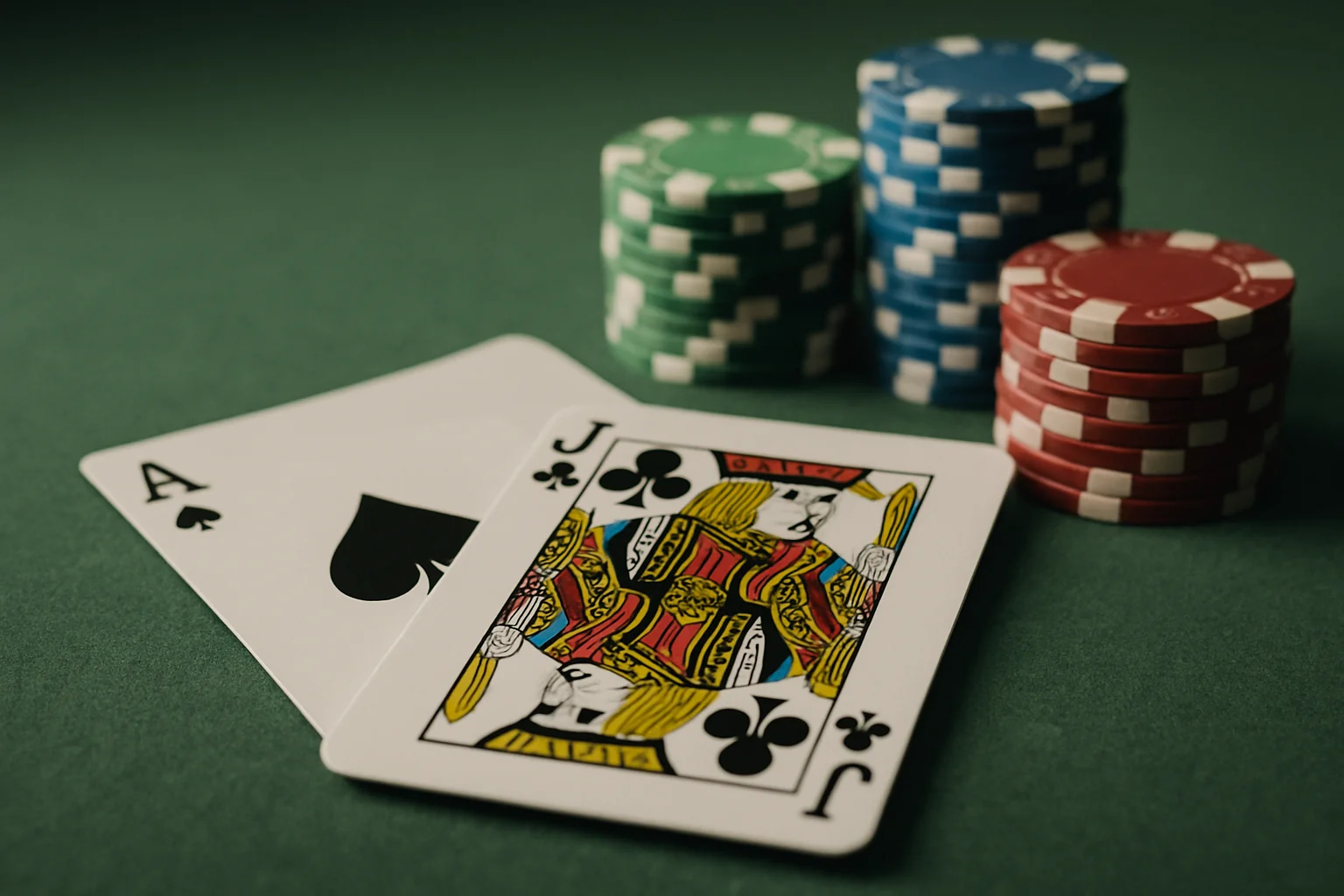
In 1994, a group of MIT students walked into the MGM Grand with a collective bankroll of $89,000 and walked out six weeks later having extracted over $400,000 from blackjack tables. They weren’t cheating—they were counting cards, using pure mathematics to flip the house edge into a player advantage. Card counting isn’t the Hollywood fantasy of memorizing every card; it’s a legal, proven system rooted in probability theory that Edward Thorp introduced in 1962 with his groundbreaking book Beat the Dealer. This article breaks down the actual mathematics: how the Hi-Lo system works, why high cards favor players, how to calculate true count and expected value, and why skilled counters can achieve a 0.5-1.5% edge over the casino. You’ll learn the numbers that beat the house—and why most people still lose trying.
The Birth of Mathematical Blackjack: Edward Thorp’s Revolution
In 1960, a mathematics professor at MIT named Edward Thorp walked into a Nevada casino with something no gambler had ever possessed: mathematical proof that the house could be beaten. Armed with calculations performed on an IBM 704 computer—a room-sized machine that cost millions—Thorp had cracked blackjack’s code. Two years later, his book Beat the Dealer hit the shelves and became an instant New York Times bestseller, selling over 700,000 copies and triggering panic among casino operators across the country.
From MIT Professor to Casino Nemesis
Thorp’s journey began with a simple question: Could mathematics overcome the casino’s edge? Using computer simulations that ran millions of hands, he developed what became known as the Ten-Count system, calculating optimal basic strategy for every possible hand combination. The IBM 704 crunched numbers for weeks, revealing something casinos had long denied—blackjack was beatable with disciplined, mathematical play.
His field tests proved devastating. In 1961, Thorp took $10,000 bankrolled by wealthy New York gamblers to Reno and Lake Tahoe. He returned with profits that validated every calculation. Casino managers watched in horror as this bespectacled professor systematically extracted money from their tables, transforming gambling from superstition and hunches into applied mathematics.
Why Blackjack Is Different from Other Casino Games
Thorp’s breakthrough hinged on one critical distinction: blackjack has memory. Unlike roulette, craps, or slots where each spin or roll is independent, cards removed from the deck change the probabilities of what remains. A deck rich in tens and aces favors the player. A deck loaded with small cards tilts toward the house.
This dependency—this mathematical fingerprint left by every dealt card—created exploitable patterns. Thorp proved that by tracking the ratio of high to low cards, players could identify moments when they held the advantage and bet accordingly. For the first time in casino history, a game’s mathematics worked against the house, and the proof was irrefutable, computerized, and available for $5.95 at any bookstore.
How Card Counting Actually Works: The Core Concept
The genius of card counting lies in exploiting a mathematical quirk that separates blackjack from every other casino game: the cards already played affect what’s coming next. When Edward Thorp published Beat the Dealer in 1962, he proved what casinos had feared—blackjack wasn’t a game of independent trials like roulette. Each card removed from the deck shifts the probabilities for every hand that follows.
Card counters aren’t psychics predicting the next card. They’re accountants tracking inventory. The fundamental principle is deceptively simple: assign a value to every card dealt, maintain a running tally, and increase your bets when the remaining deck composition favors you. Harvey Dubner’s Hi-Lo system, introduced in 1963, became the gold standard by using a straightforward formula: low cards (2-6) get tagged as +1, neutral cards (7-9) as 0, and high cards (10 through Ace) as -1. When the count climbs into positive territory, the shoe is rich with tens and aces. That’s when skilled counters press their advantage.
Why High Cards Favor the Player
A deck loaded with high cards creates multiple advantages that tilt the mathematics away from the house. Blackjacks pay 3:2, and they occur more frequently when tens and aces dominate the remaining cards—and while both player and dealer get the same number of blackjacks over time, the player earns that premium payout while the dealer doesn’t.
High cards also make dealer busts more likely. Dealers must hit on 16 and stand on 17, a rigid rule that becomes a liability when the deck is ten-heavy. Players can stand on stiff hands, but dealers march dutifully toward bust city. Additionally, doubling down and splitting pairs—moves restricted to players—become more profitable when you’re likely to catch a ten or ace.
The Running Count vs. True Count
In single-deck games, the running count tells the whole story. But modern casinos typically use six to eight decks, which dilutes the impact of any running count. A running count of +6 means something entirely different with six decks remaining versus one deck remaining.
The true count solves this problem by normalizing the running count against the decks left to play. Divide your running count by the estimated number of remaining decks, and you get the true count—the actual measure of your advantage. A true count of +3 or higher typically signals a 0.5% to 1.5% player edge, the green light for increasing bet sizes from table minimum to strategic maximums.
The Hi-Lo System: Card Counting’s Most Popular Method
When Harvey Dubner refined the point-count system in 1963, he created what would become the backbone of professional blackjack play for the next six decades. The Hi-Lo system strikes that rare balance between simplicity and power, with a betting correlation of 0.97 and playing efficiency of 0.51—numbers that translate to real money at the tables without requiring a PhD in mathematics.
The genius of Hi-Lo lies in its streamlined card values. Cards 2 through 6 receive a +1 value, representing the small cards that favor the house. Cards 7, 8, and 9 count as 0—they’re essentially invisible to your count. And the high cards, 10 through Ace, get tagged with -1 because these are the player’s friends, the cards that make blackjacks and strong hands.
How to Calculate the Running Count
Start each shoe at zero. As cards hit the felt, you adjust your mental tally:
- Add one when you see 2, 3, 4, 5, or 6
- Do nothing for 7, 8, or 9
- Subtract one for 10, Jack, Queen, King, or Ace
Let’s walk through a real hand. The dealer shows a 6, you have King-5, another player holds 10-3. Your running count moves like this: +1 for the 6, -1 for your King, +1 for your 5, -1 for the other player’s 10, +1 for their 3. You’re sitting at +1 after that single hand.
Converting to True Count for Multi-Deck Games
The running count tells only half the story in the six-deck shoes you’ll find at most casinos. A running count of +6 means something drastically different with six decks remaining versus one deck remaining. This is where true count enters the equation.
Take your running count and divide it by the number of decks left in the shoe. If your running count sits at +8 and you estimate four decks remain, your true count is +2. That same +8 running count with only two decks left? Now you’re looking at a true count of +4—a substantial edge that justifies increasing your bet significantly. Professional counters estimate remaining decks by eyeballing the discard tray, a skill that comes with hundreds of hours at the tables.
The Numbers Game: Calculating Your Actual Edge
A skilled card counter using the Hi-Lo system at a six-deck blackjack table can flip the house edge, achieving somewhere between 0.5% and 1.5% advantage over the casino. That sounds modest—and it is. This razor-thin edge means grinding through thousands of hands, weathering brutal swings, and sizing bets with mathematical precision. The difference between a profitable counter and a broke wannabe often comes down to understanding expected value and managing variance.
When the true count hits +3, you’re sitting on roughly a 1% edge. A $100 bet at that moment has an expected value of $1. Play a hundred such hands, and you’re theoretically up $100. But variance doesn’t care about theory. The standard deviation in blackjack hovers around 1.15 bets per hand, meaning wild swings are baked into the game. You might win twelve consecutive hands or lose eight straight—all while maintaining a mathematical advantage.
The Kelly Criterion Explained
The Kelly Criterion solves a critical problem: how much should you bet when you have an edge? The formula is straightforward: bet a percentage of your bankroll equal to your advantage divided by variance. With a 1% edge, Kelly suggests wagering roughly 0.87% of your total bankroll on that hand. Most professional counters use fractional Kelly—typically one-quarter or one-half—because full Kelly betting produces stomach-churning volatility.
In practice, card counters spread their bets from table minimum to 8-12 times that amount. A player at a $25 table might bet $25 at negative counts and push it to $200-$300 when the count screams positive. This spread maximizes profit while attempting to stay under the casino’s radar.
Bankroll Requirements and Variance
The mathematics demand serious capital. A counter playing with maximum bets of $100 needs a bankroll between $10,000 and $20,000 to weather standard deviation without going broke. That’s 100-200 times the max bet—the cushion required to survive those inevitable losing streaks that can drain 20, 30, even 40 max bets before regression to the mean kicks in.
Professional teams like those featured in the MIT blackjack story operated with six-figure bankrolls precisely because variance doesn’t negotiate. Your edge might be real, but it only materializes across thousands of hands.
The MIT Blackjack Team: When Math Became Millions
Between 1979 and the early 2000s, a rotating cast of MIT students and alumni turned blackjack tables into their personal ATMs, extracting over $5 million from casinos across Las Vegas, Atlantic City, and the Caribbean. What made them legendary wasn’t just that they won—it was how they weaponized mathematics, psychology, and military-level coordination to beat the house at its own game.
The Spotter-Big Player System
The team’s innovation was simple but devastating. Instead of lone counters grinding out profits while drawing heat, they deployed a network. Spotters sat at tables making minimum bets—typically $10 to $25—appearing to be casual tourists losing slowly. These spotters maintained running counts using the Hi-Lo system, tracking every card that hit the felt. When the true count climbed to +2 or higher, signaling a deck rich in tens and aces, they’d signal a Big Player.
The Big Player would swoop in like a high-rolling whale, betting $500 to $5,000 per hand with no warm-up. To pit bosses, this looked like typical gambler behavior—erratic, emotional, luck-based. But these weren’t gut bets. They were mathematically optimal strikes launched precisely when the house edge flipped 1% to 2% in the player’s favor. After the shoe turned cold, the Big Player would cash out and drift away, preserving the illusion of a lucky streak.
How They Avoided Detection
The team’s longevity came from their obsession with camouflage. Big Players wore expensive suits, ordered premium drinks, tipped dealers generously, and occasionally made deliberately bad plays to appear amateurish. They rotated personnel across casinos weekly, maintained false identities, and used hand signals disguised as natural gestures—scratching an ear, adjusting chips, casual conversation.
Bill Kaplan, who managed the team’s most profitable era in the 1980s, ran operations like a hedge fund. Players received salaries and performance bonuses. Bankroll management followed strict Kelly Criterion principles to minimize risk of ruin. The team even conducted regular “checkout sessions” where members had to demonstrate flawless counting and betting accuracy before hitting the casino floor.
Advanced Systems and Diminishing Returns
Harvey Dubner’s Hi-Lo system commands about 75% of all professional card counting operations, not because sharper tools don’t exist, but because the alternatives demand cognitive bandwidth that most human brains can’t sustain across 100-150 hands per hour while executing perfect basic strategy.
The mathematics tells an interesting story. Systems like Wong Halves and Hi-Opt II squeeze out marginally better playing efficiency—Wong Halves climbs to 0.56 compared to Hi-Lo’s 0.51—but the price is steep. Instead of simple +1, 0, -1 values, Wong Halves assigns fractional counts: 5s count as +1.5, 3s and 4s as +1, 2s and 7s as +0.5, while 9s rate -0.5. Your brain becomes an abacus tracking half-points while pit bosses circle and cocktail servers interrupt your concentration every twelve minutes.
| System | Betting Correlation | Playing Efficiency | Card Values | Mental Demand |
|---|---|---|---|---|
| Hi-Lo | 0.97 | 0.51 | 3 levels (+1, 0, -1) | Moderate |
| Hi-Opt II | 0.91 | 0.67 | 5 levels (+2, +1, 0, -1, -2) | Very High |
| Wong Halves | 0.99 | 0.56 | 7 levels (including half-points) | Extreme |
The professionals who actually earn six figures annually from blackjack understand the grind. That extra 0.05 in playing efficiency might translate to an additional 0.1% edge—meaningful over ten thousand hands, negligible when you’re making errors on hand 87 because you’re mentally exhausted tracking whether the last three cards were +1.5 or +1.
MIT Blackjack Team veterans consistently report that maintaining Hi-Lo across marathon six-hour sessions already pushes human limits. Add alcohol exposure, dealer chatter, and the surveillance pressure of knowing cameras track your bet spreads, and the argument for simplicity becomes mathematical. The best system is the one you can execute flawlessly when you’re tired, slightly buzzed from comp drinks, and sitting next to a chain-smoker telling bad beat stories.
The Casino Countermeasures: How Houses Fight Back
When Ken Uston walked into Resorts International in Atlantic City during the early 1980s, security escorted him out within minutes. He hadn’t cheated, stolen chips, or caused a disturbance. His crime? Thinking too well at the blackjack tables. Uston sued, and the resulting New Jersey Supreme Court decision established a precedent that still shapes the legal battlefield between casinos and card counters today.
Why Card Counting Is Legal
Card counting exists in a legal gray zone that confuses most players. Using your brain to track cards is perfectly legal in every U.S. jurisdiction because it’s pure mental calculation—no devices, no cheating, just mathematics applied in real-time. However, casinos operate as private businesses with the right to refuse service to anyone, provided they’re not discriminating based on protected characteristics like race or religion. Being good at math isn’t a protected class.
This creates the paradox: you can’t be arrested for counting cards, but you can absolutely be banned from playing. Casinos call it “backing off” a player. Atlantic City casinos face stricter regulations than Nevada—they cannot ban skilled players outright but can impose betting restrictions that make counting unprofitable.
Modern Casino Defenses
Las Vegas casinos have evolved sophisticated countermeasures since the 1960s boom in card counting following Edward Thorp’s Beat the Dealer. The most common defense is sheer deck volume. Single-deck games, where counters held a decisive edge, have largely vanished. Today’s standard six to eight-deck shoes dramatically reduce counting effectiveness by diluting the statistical impact of removed cards.
Continuous shuffling machines (CSMs) represent the nuclear option—they shuffle cards back into the deck after every hand, making counting mathematically impossible. You’ll find these machines spreading across lower-limit tables nationwide.
Deck penetration—how deeply dealers cut into the shoe before shuffling—has shrunk considerably. Many casinos now shuffle with 1.5 to 2 decks remaining, cutting off the most profitable counting opportunities. Meanwhile, facial recognition software quietly catalogs known counters, sharing databases across casino networks. Griffin Investigations once maintained the industry’s most notorious blacklist until lawsuits forced its closure in 2005, but casino surveillance technology has only grown more sophisticated since.
The Reality Check: Time, Skill, and Bankroll Requirements
Even with a proven 1% edge over the house, a card counter needs 400-500 hours at the tables to reach 95% confidence of actually showing profit. That’s roughly three months of full-time play, or an entire year of serious weekend sessions. The mathematics of variance don’t care about your technique—short-term swings can and will punish even perfect execution.
Before you ever adjust a bet based on the count, you must achieve absolute mastery of basic strategy. We’re talking 99%+ accuracy under casino conditions: drunk players talking over you, cocktail servers asking for orders, pit bosses watching, and that guy at third base making idiotic plays. Basic strategy errors of just 0.5% completely erase the typical counting advantage. Most aspiring counters underestimate this foundation requirement by six months.
The bankroll mathematics are brutal and non-negotiable:
- Conservative approach: 200 maximum bets ($10,000 for a $50 max bet spread)
- Aggressive approach: 100 maximum bets ($5,000 for a $50 max bet spread, accepting higher risk of ruin)
- Realistic variance swings: Expect to experience losing streaks of 15-20 maximum bets regularly
- True hourly rate: After travel, lodging, meals, and tokes, many counters earn $15-35 per hour with a $10,000 bankroll
The hidden costs destroy more card counting careers than casino heat ever could. Mental fatigue from maintaining perfect concentration across eight-hour sessions leads to costly mistakes. Casino personnel scrutinize bet spreads and playing deviations—one backoff means burning that property permanently. Travel expenses to rotate between casinos eat 20-30% of theoretical earnings.
The MIT Blackjack Team succeeded not because counting was easy, but because they operated with $1 million+ in collective bankroll, rotated players to avoid detection, and treated it like the full-time job it actually is.
The Mathematics Wins—If You Can Execute
Edward Thorp proved in 1962 that blackjack could be beaten, and sixty years of casino profits extracted by skilled counters have validated his mathematics beyond any doubt. The Hi-Lo system works. The Kelly Criterion optimizes bet sizing. True count calculations accurately identify player advantage. The MIT Blackjack Team’s $5 million in winnings stands as irrefutable proof that probability theory can overcome the house edge.
But here’s the reality: card counting represents one of the few legitimate opportunities to gain a mathematical edge in a casino game, yet it demands a level of discipline, bankroll, and mental endurance that eliminates 95% of people who attempt it. You’re not just learning a system—you’re committing to hundreds of hours of practice, tens of thousands in bankroll, constant travel to avoid detection, and the psychological stamina to execute flawlessly while losing streaks drain your account.
The mathematics is sound. The question is whether you have the resources and dedication to let those numbers work across the thousands of hands required for the edge to materialize. For those who can meet these demands, card counting remains what it’s always been: a testament to the power of applied probability over casino odds, legal and proven, waiting for players skilled enough to claim their advantage.
