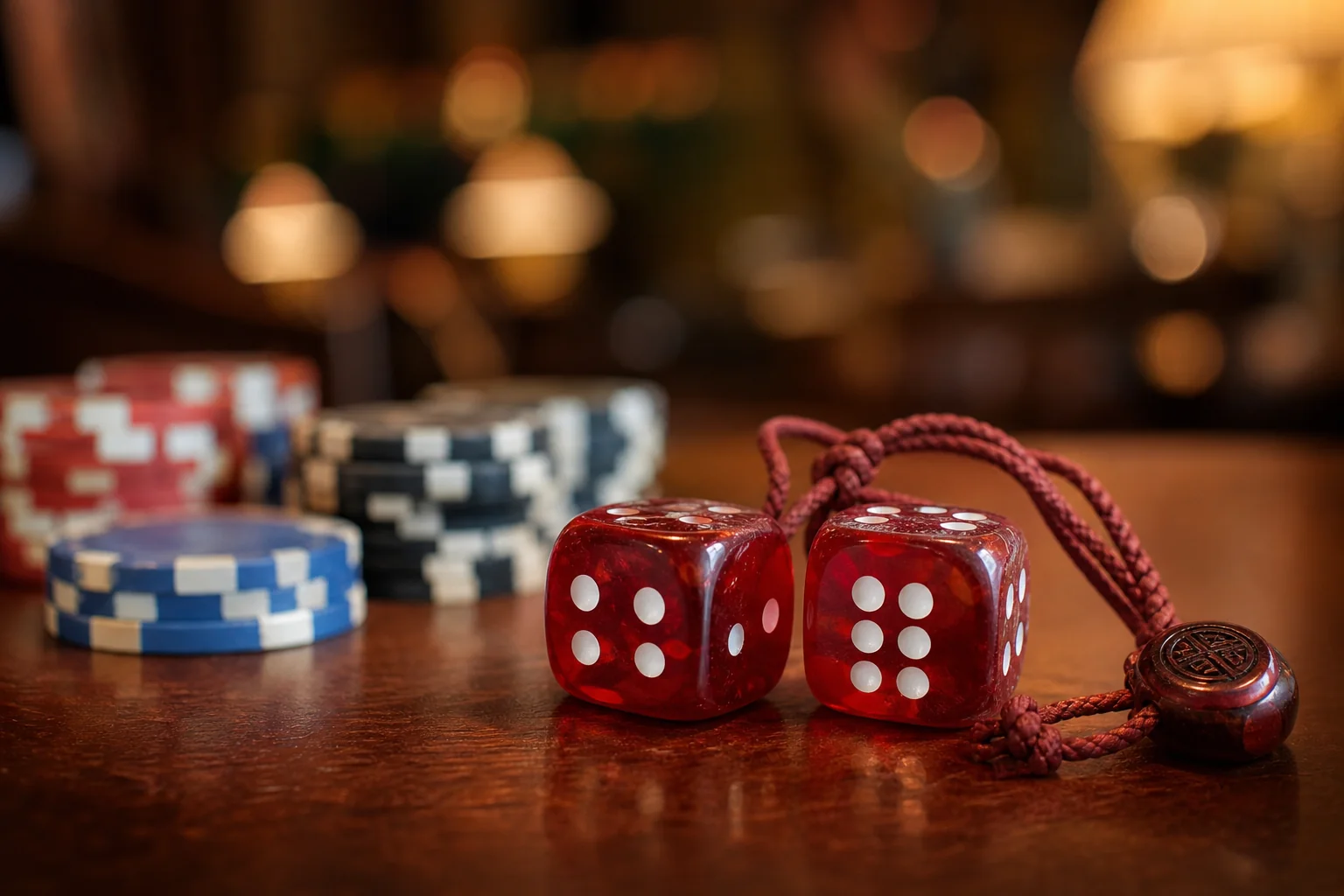
At a high-stakes poker table in Las Vegas, a seasoned player arranges her chips in precise stacks, taps the felt twice, and touches a faded rabbit’s foot before every hand. Across the casino floor, a craps shooter whispers to the dice before launching them down the table. These aren’t isolated quirks—they’re windows into one of gambling’s most persistent paradoxes: why do rational adults believe lucky charms can influence outcomes governed entirely by mathematics? Research shows that the overwhelming majority of regular gamblers engage in some form of superstitious behavior, despite knowing the odds remain unchanged. The answer lies in powerful psychological mechanisms that evolved to help humans survive, but now lead them to see patterns in randomness, feel control over chance, and remember wins while forgetting losses. Understanding these mental tricks won’t make you luckier, but it might make you smarter.
The Gambler’s Fallacy: When Past Spins Haunt Future Bets
On August 18, 1913, the roulette wheel at Monte Carlo’s Casino de Monte-Carlo landed on black twenty-six times in a row. By the fifteenth spin, players were frantically piling chips onto red, convinced the wheel was “due” for a correction. They lost millions of francs that night, victims of what psychologists now call the gambler’s fallacy.
The 1913 Monte Carlo Incident
That legendary evening created a textbook example of flawed probability reasoning. As black kept hitting, bettors assumed each consecutive result made red more likely. The crowd’s logic felt ironclad: how could black possibly continue defying the odds? But the roulette wheel has no memory. Each spin carries the same 18-in-37 chance of landing red on a European wheel, regardless of what happened seconds or hours before. The wheel doesn’t know it just hit black twenty-six times. It doesn’t care about your mounting losses or the desperate belief that the universe owes you a correction.
Why Your Brain Sees Patterns in Randomness
Your brain evolved to detect patterns for survival, not to calculate independent probability. When ancient humans noticed rustling grass preceded predator attacks, pattern recognition kept them alive. But this same wiring betrays modern gamblers. Research shows that 72% of slot machine players believe certain machines run “hot” or “cold,” despite each spin being generated by a random number algorithm with no connection to previous results.
The mathematics are unforgiving. A slot machine that just paid out a jackpot has identical odds on the next pull. A blackjack shoe that dealt ten face cards in a row hasn’t exhausted some cosmic quota of high cards—assuming proper shuffling, the remaining deck maintains its statistical composition. Craps shooters who think a table has gone cold are watching independent dice rolls, each with fixed probabilities that remain unchanged by history.
This cognitive trap explains why gamblers chase losses and abandon winning strategies after short cold streaks. They’re fighting a phantom pattern their minds have constructed from random noise.
The Illusion of Control: Why Gamblers Blow on Dice and Tap Screens
Walk into any casino and you’ll witness the theater of control: craps players shaking dice like maracas, blackjack enthusiasts tapping cards before revealing them, slot players stroking screens in specific patterns. These aren’t just quirks. They’re manifestations of a deeply embedded cognitive bias psychologist Ellen Langer identified in 1975 as the “illusion of control”—the belief that personal actions can influence outcomes governed entirely by chance.
Physical Rituals at the Casino Floor
The phenomenon operates on deceptively simple logic. When a dice thrower launches harder and gets the number they wanted, their brain forges a causal link that probability alone can’t explain. Blowing on cards before a deal, rubbing a slot machine’s screen, or pressing the button with a specific finger—these rituals create what psychologists call “agency feedback.” The physical act itself generates a sense of participation in the outcome, transforming passive waiting into active involvement.
This psychological comfort explains why digital gambling hasn’t eliminated tactile superstitions. Online players develop new rituals: clicking at precise moments, refreshing browsers between spins, or touching their screens in designated patterns. The medium changes, but the need for perceived influence remains constant.
When Control Actually Matters: Skill vs. Chance
Understanding this distinction separates informed gamblers from delusional ones. Roulette, slots, and craps operate on pure mathematics—no amount of breath, pressure, or timing alters the random number generator or the ball’s trajectory. Poker and sports betting, however, reward genuine skill: hand selection, position awareness, and statistical analysis create measurable edges.
The danger emerges when players misattribute variance to ritual. A craps shooter who wins after their “lucky throw” strengthens a false pattern. Casino operators don’t discourage these behaviors because they extend play sessions and deepen emotional investment in outcomes that remain, fundamentally, beyond anyone’s control.
How Your Brain Gets Tricked: Intermittent Reinforcement and Near Misses
Your lucky rabbit’s foot failed you nine times straight at the blackjack table. On the tenth hand, you hit a natural 21. Suddenly, that rabbit’s foot isn’t just a trinket—it’s sacred. This isn’t stupidity. It’s your brain running a program refined over millions of years, now hijacked by casino mathematics.
The Power of Occasional Wins
Neuroscientists call it intermittent reinforcement, and it’s the most powerful behavioral conditioning pattern known to psychology. When a ritual occasionally precedes a win, your brain forges a causal link that’s nearly impossible to break. The math works against you, but your memory doesn’t care. One success after kissing your chips overwhelms ten failures in your neural filing system because wins trigger dopamine floods that losses simply don’t match.
Slot machines exploit this mercilessly through the near-miss effect. When two sevens land and the third stops one symbol away, your brain’s reward centers light up almost identically to an actual win. Research shows these near-misses activate the same neural pathways as genuine jackpots, fooling your cortex into thinking you’re “getting close.” You’re not. Each spin is mathematically independent, but tell that to your anterior insula, which is buzzing with anticipation.
Your Brain on Lucky Charms
Recent studies found that gamblers who engaged in pre-game rituals showed 23% lower cortisol levels compared to those who skipped the ceremony. The ritual itself—regardless of outcome—provides measurable stress relief. Your brain rewards you for performing the superstition, creating a feedback loop entirely separate from whether you win or lose.
This neurological quirk explains why professional poker players who understand probability still tap the table twice or arrange chips in specific patterns. The cortisol reduction is real. The sense of control, however illusory, genuinely calms your nervous system. Your rational mind knows the cards don’t care about your routine. Your limbic system doesn’t speak statistics.
Lucky Numbers and Cultural Superstitions Around the World
Walk into the Wynn Macau and you’ll notice something curious: the elevator buttons skip from floor 3 to floor 5, then leap from 39 straight to 50. The number 4 is systematically erased from the building’s architecture. This isn’t an oversight—it’s a calculated response to one of gambling’s most powerful cultural superstitions. In Mandarin and Cantonese, the word for “four” sounds nearly identical to “death,” making it as unwelcome in Chinese casinos as a dealer caught cheating.
East Meets West: Number Superstitions
The divergence between Eastern and Western lucky numbers creates a fascinating split in global gambling culture. Chinese players flock to baccarat tables featuring the number 8, which phonetically resembles “prosperity” in Mandarin. High rollers will pay premium prices for hotel rooms ending in 88 or VIP suites on the 8th floor. Phone numbers with multiple 8s command extraordinary prices in Asian markets—one Beijing businessman famously paid $280,000 for the mobile number 8888-8888.
Western gamblers, meanwhile, clutch their lucky 7s like religious talismans. The number dominates slot machine symbolism, appears in casino branding worldwide, and traces its mystical reputation back to medieval Christian theology and ancient Babylonian astronomy. Conversely, 13 carries such negative weight that many Las Vegas casinos omit the 13th floor entirely, jumping from 12 to 14 in their numbering.
This numerical divide has ancient roots. Roman gamblers consulted augurs before wagering on gladiator matches, seeking divine approval through bird flight patterns. Medieval dice players invoked Saint Cajetan, the patron saint of gamblers, before each throw.
How Casinos Cater to Cultural Beliefs
Modern casinos have become masterful anthropologists, adapting their designs to honor cultural superstitions:
- MGM Macau spent millions reconfiguring its main entrance after feng shui consultants determined the original design allowed prosperity to “flow out”
- Bellagio Las Vegas removed certain table numbers from its high-limit rooms to accommodate Asian VIP preferences
- Crown Casino Melbourne offers separate gaming areas with culturally-specific décor and number schemes for different demographic groups
Approximately 90% of high-roller VIP rooms in Macau casinos are designed according to feng shui principles, with careful attention to mirror placement, water feature positioning, and directional orientations. These aren’t mere decorative choices—they represent hundreds of millions in design investments based on the mathematical reality that superstitious players stay longer and bet bigger when their beliefs are validated by their surroundings.
Common Casino Superstitions: What Gamblers Actually Do
Walk into any casino at 3 AM and you’ll witness a silent theater of ritual: a craps player blowing on dice, a blackjack enthusiast refusing seat number seven, a slot devotee kissing a worn rabbit’s foot before each spin. These aren’t outliers. Studies reveal that up to 80% of regular gamblers engage in some form of superstitious behavior, turning games of chance into elaborate personal ceremonies.
The numbers tell a compelling story about what gamblers actually believe. According to recent research, 53% of casino-goers swear by lucky numbers—whether it’s always betting on 17 at roulette or requesting table positions that add up to their birth date. Close behind, 47% maintain lucky clothing or accessories, from “winning socks” that haven’t seen a washing machine in months to jewelry passed down through generations.
The rituals themselves span a fascinating spectrum:
- Carrying physical talismans: Four-leaf clovers, lucky coins, religious medallions, or photographs tucked into wallets
- Pre-game preparations: Poker players entering through specific casino doors, circling their chair three times before sitting, or ordering the same drink before every tournament
- Active gestures during play: Crossing fingers, tapping the table a certain number of times, or rubbing chips together before placing bets
- Strategic seat selection: Avoiding chairs where previous players lost, claiming specific positions believed to have better “energy”
But superstition also dictates what not to do. Seasoned players know the unwritten rules: never whistle at a craps table (it supposedly summons bad luck), don’t count your chips while still playing (folklore says it angers the gambling gods), and avoid crossing your legs while betting (believed to “cross out” your luck). These prohibitions are enforced not by pit bosses but by fellow gamblers shooting disapproving glares.
Superstition vs. Routine: What Professional Gamblers Know
Daniel Negreanu wears the same hoodie. Phil Ivey stacks his chips in identical towers. These aren’t superstitions—they’re psychological anchors. The difference matters more than most gamblers realize, especially when it comes to protecting your bankroll.
The Pro’s Perspective
Professional poker players draw a sharp line between magical thinking and functional routine. They understand that shuffling chips in a specific pattern won’t change the cards, but the muscle memory quiets the mind. The ritual doesn’t influence probability—it influences focus. Tournament veterans construct elaborate pre-game sequences not because they believe in lucky socks, but because consistency breeds mental clarity. A familiar routine triggers the brain’s readiness state, lowering cortisol and sharpening decision-making during high-pressure hands.
The distinction becomes critical when money management enters the equation. A player who touches the felt three times before betting isn’t harming anyone. A player who believes red cards run hot after midnight and adjusts bet sizing accordingly is headed toward ruin. Research has shown that superstitious behaviors can actually improve performance in skill-based games by reducing anxiety and increasing confidence—but only when the gambler understands the mechanism. The moment you attribute variance to cosmic forces rather than mathematics, you’ve crossed into dangerous territory.
When Rituals Actually Help Your Game
Beneficial routines share common traits: they’re time-bound, they enhance concentration, and they acknowledge reality. Breathing exercises before tournament play work because physiology affects cognition. Lucky rabbits’ feet don’t work, but if carrying one makes you feel 2% calmer and that calmness prevents a tilt-induced bluff, the object has served a psychological purpose—not a supernatural one. The bankroll killer isn’t the ritual itself. It’s the belief that the ritual controls outcomes, leading to bet sizing based on perceived magic rather than mathematical edge.
The Bottom Line: Should You Trust Your Lucky Charm?
Your lucky poker chip won’t change the cards, but it might change your game. The question isn’t whether superstitions affect probability—they don’t—but whether they affect you.
Here’s the practical math: wearing your “lucky” shirt to the blackjack table doesn’t alter the house edge by a single decimal point. The roulette wheel has no memory of your ritual. A pair of dice will never care about your breathing pattern. In games of pure chance, every ritual is mathematically irrelevant.
But psychology isn’t irrelevant. If your pre-game routine calms your nerves and helps you think clearly at the poker table, it’s serving a purpose. The key is understanding the difference between a helpful ritual and a dangerous delusion.
Keep your superstitions if they:
- Reduce anxiety and help you enjoy the experience
- Create a consistent mental routine that aids focus
- Don’t cost money beyond your existing bankroll
- Won’t cause emotional meltdown if you skip them
Abandon superstitions immediately if they:
- Lead you to bet more than planned because conditions feel “right”
- Make you chase losses because you’re waiting for luck to “turn”
- Override basic bankroll management or strategy decisions
- Create anxiety or compulsion around gambling activities
Think of lucky charms like pre-game playlists for athletes. They don’t improve muscle mass or reaction time, but they establish mental readiness. Your rabbit’s foot might help you sit down relaxed, but it won’t help you calculate pot odds.
The smartest gamblers treat their rituals as entertainment accessories, not edge generators. Blow on the dice if it feels good. Just make sure you’re betting with your head, not your lucky streak.
The psychological forces driving casino superstitions—the gambler’s fallacy, the illusion of control, intermittent reinforcement—are hardwired into human cognition. They evolved to help our ancestors survive in uncertain environments, but they weren’t designed for the mathematically precise world of casino gaming. Understanding these mechanisms doesn’t make you immune to their pull, but it does give you a choice: you can enjoy your rituals for what they are—comforting routines that enhance the entertainment value of gambling—without letting them hijack your decision-making.
The best gamblers know that superstitions can’t change the odds, but sound bankroll management and mathematical literacy can change your outcomes. Use your lucky charm if it makes the game more fun. Wear your winning shirt. Tap the table twice before every hand. Just never let these rituals replace the fundamentals: know the house edge, stick to your limits, and remember that every spin, every deal, every roll is governed by probability, not magic. Informed enjoyment beats blind faith every time.
